An Augmented Reality Holographic Construction APP
APP on Microsoft HoloLens + Fologram RMIT
Individual Work UCL 2018
01.2018-08.2018
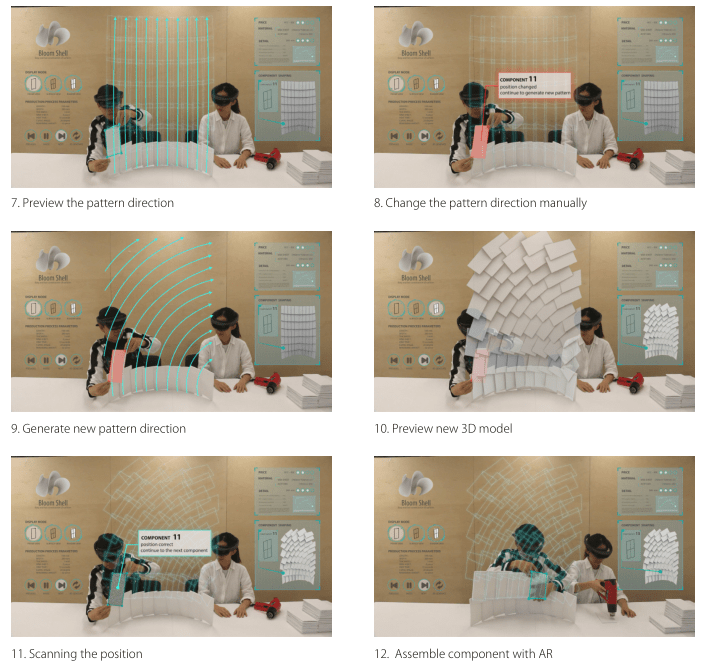
The latest mixed reality references and changes the direction of the pattern. The builder can construct the construction according to the original design. At the same time, designers can change the direction of the pattern at any time according to their aesthetic orientation and design intent. When hololens detects that the component is not designed as designed, it will remind the builder whether to generate a new solution based on the new component location.
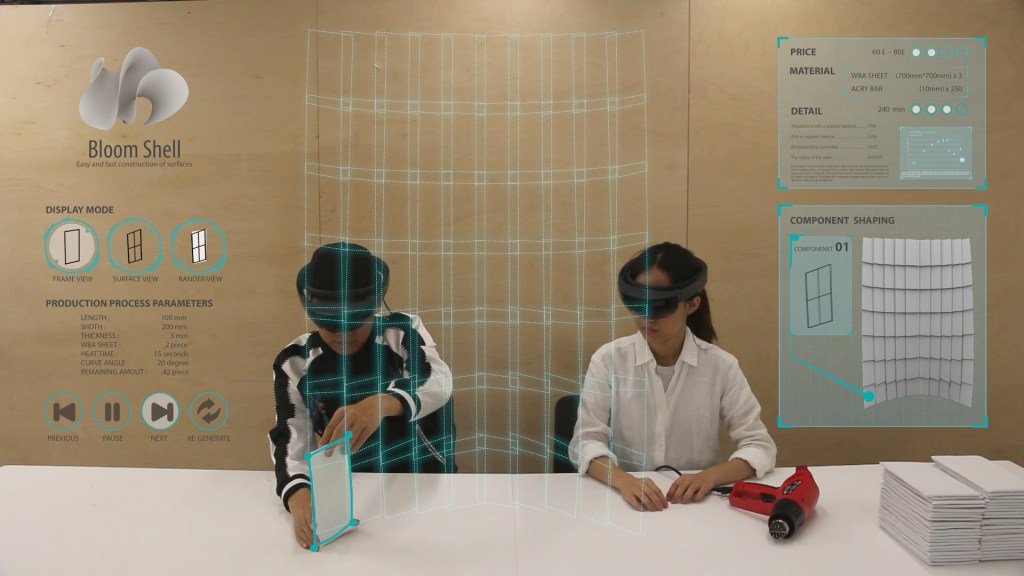
In order to achieve that, we upgraded out AR interface to adapt the tile component system. Designers can choose the object which they want fabricate first, after that, they can choose the shape of the tile component such as rectangle or oval, etc. and preview that in the Augmented Reality device. The detail information of the object will be shown by the holographic instruction in Microsoft HoloLens including the number of tile component the designer need to prepare, the location of each component and the fabrication time. Designers can also control the construction process by themselves using “Tap” gesture . The material of the tile component is lightweight, the direction of the component does not influence or change the structural properties of the surface itself, but can bring the various outcomes of the surface instead. The idea of changing tile direction will lead this research into an immersive interactive design, which allows designer to make changes to the component direction on a local scale while maintaining the whole shape on a global scale to give more detail outcomes. The headset sensor will detect the transformation and send it to design software to generate a new outcome. For example, the designer can active the interface by “Tap” gesture and choose the favorite object. If the designer decides to build a wall, a self-standing wall with basic panel will be calculated by computer and shown as holographic object in Microsoft HoloLens . However, during the assembly process, the designer decides to change the orientation of the next panel, the computer will recalculate and give the evolution scheme of the remaining panels, while keeping the original wall shape [Figure]. This process can be done repeatable at any time during the assembly process. This idea will build a bridge between human and computer to let machine learn and give calculated reasonable outcomes at any time human make new decisions. That will be a new Artificial Intelligence exploration through Augmented Reality Technology.


 YSDesign