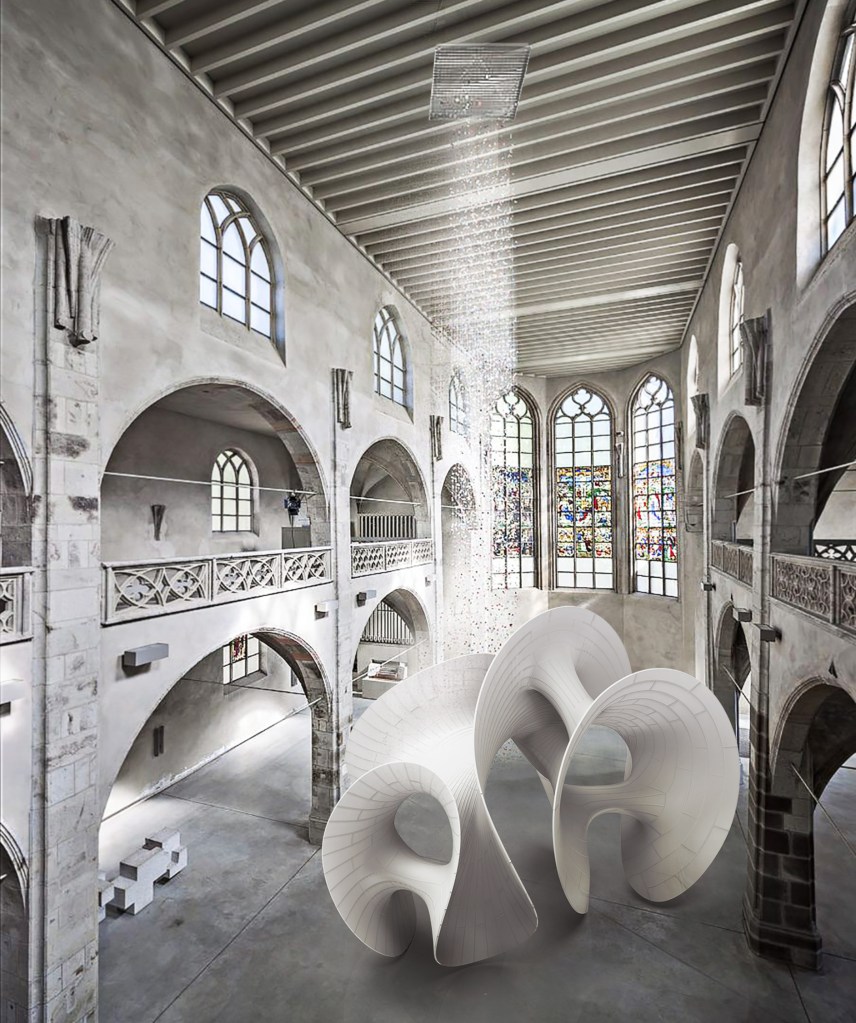
An Augmented Reality Holographic Construction Pavilion
Space & Fun & Installation
Individual Work UCL 2018
01.2018-08.2018
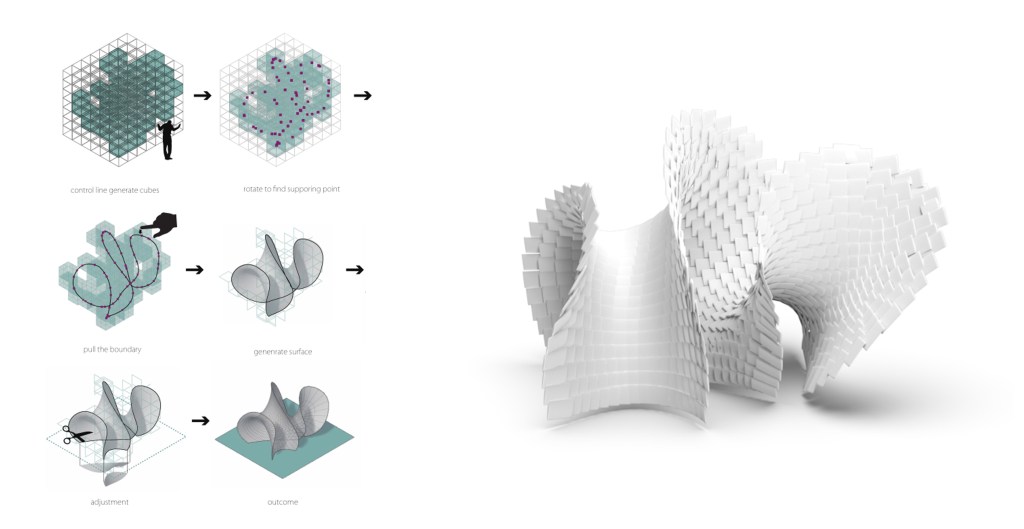
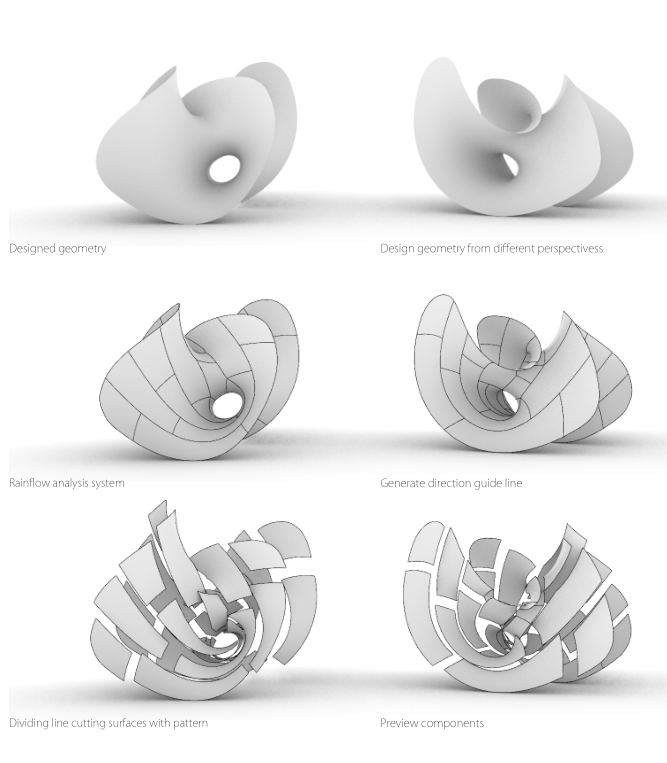
In this scenario, we continue to use the rainflow system to non-analyse the designed package surface and generate a well-structured boundary. Adjust the density of the rainflow line and make the dividing line a part of the design. At the same time, the adjusted lines and the components are combined with each other, and the boundaries of each other are pasted to make the structural parts more reasonable and substantial. As it is expected to grow later, we just make it as an origin form. Ideally, we can overlap more components to make it grow to different geometry. We want to use a kind of geometry we designed before to truly test if this method can work and how well it works. The form showed blow is a part of pavilion we designed. So firstly we use rain flow analysis system to extract its’ structure principle lines as the panel seams and growth direction.After that , we used rectangular as the basic element to penalize it.So we can get many components. As it is expected to grow later, we just make it as an origin form. Ideally, we can overlap more components to make it grow to different geometry.
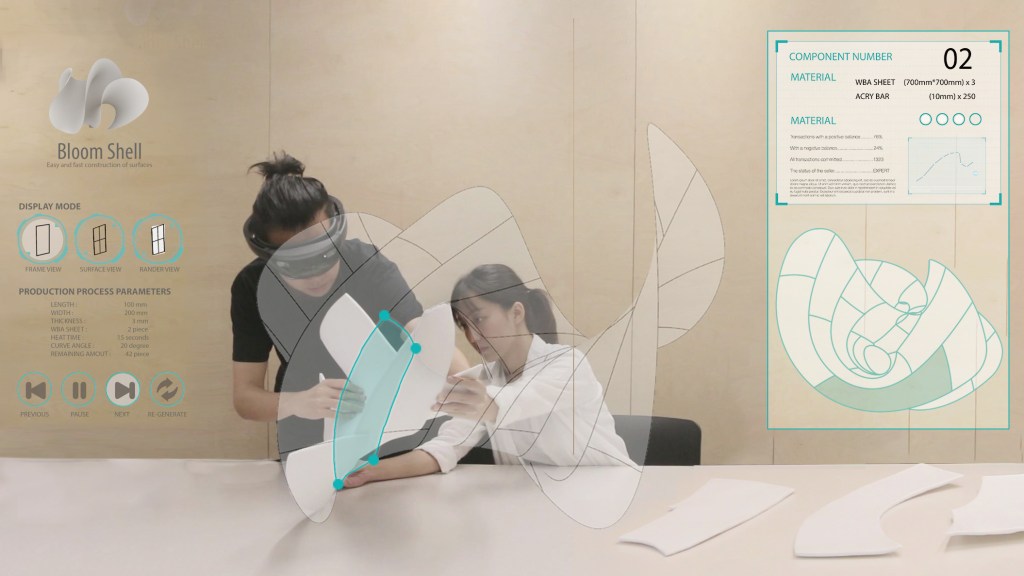
AUGMENTATION APPLICATION For the past, we used AR technology to help us do a lot of things in diverse process.But it is too complicated and difficult to control precisely in each step.So we wanted to optimize the application of augmentation. For our new martial and workflow, we can just apply AR to help us simply shape each component and assemble them together,which means the accuracy and operation convenience boot. Fologram is the most convient way to experience 3D content through hololens in mixed reality for now. It is used to collaborate with multiple devices to model in mixed reality, interact with holograms in real time as well. In the project, we combine the screen view with the actual mode through holographic in augmented reality space (NExT Lab.). At the beginning of the project, fologram software can also employ a device’s sensor to identify the shape of every single panel then send data back to the computer. The computer then displays the details of each panel for the user , such as position, sort number, and so on. At the same time, fologram technology is used to add markup or change to 3D model in mixed reality space. When two devices run a fologram program at the same time, they can cooperate in real time to complete the modelling work.
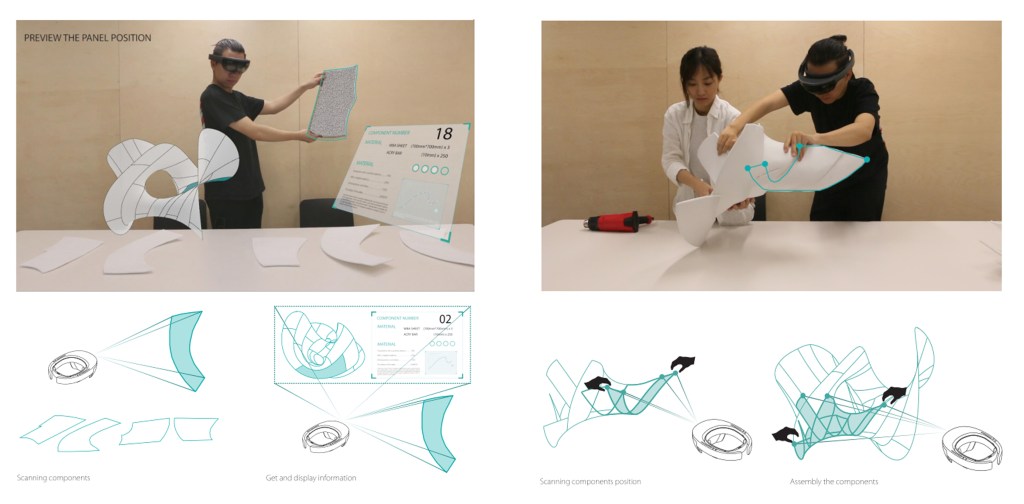
After finishing the physical components and design, builders can use augmentation to guide them to connect the components in an efficient order to achieve fast assembly. Firstly, by waring HoloLens, builders can use HoloLens scan the components to recognize the one, which should be placed in first order. Inside the view of HoloLens, people will see detailed information and the place of the component in the digital model will be highlighted. And then connect next one together. Thirdly, the second step will be repeated until finishing the fabrication. After that, when people finish the construction, if they want to continue, they will see the rest unbuilt digital parts, which is overlapped in their partly built physical model. And they can follow the connection order of components showed in the HoloLens to do the growable construction.
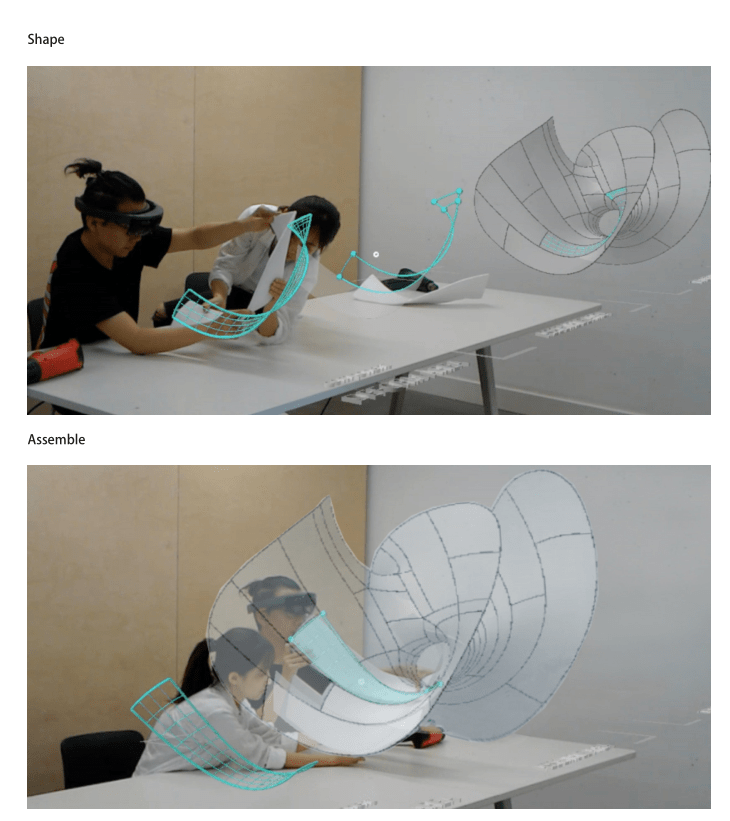
As a result, integrating mixed reality in the bottom-up complex curved surface construction enables to eliminate errors as much as possible and allows designers to add new possibilities and do modification in time. In addition to that, with the enhancement of accuracy in construction, it can achieve the goal of avoiding unnecessary time and material waste, excessive labour input, as well as the increase in cost. On this preliminary research, we have observed that the application of mixed reality in the bottom-up complexly curved surface process can not only boost the fabrication of physical components’ fabrication, but also help designers and clients to do an effective selection in various design results, change the style of components and generate creative outcome according to real-time feedback of partly built physical model.

 YSDesign